
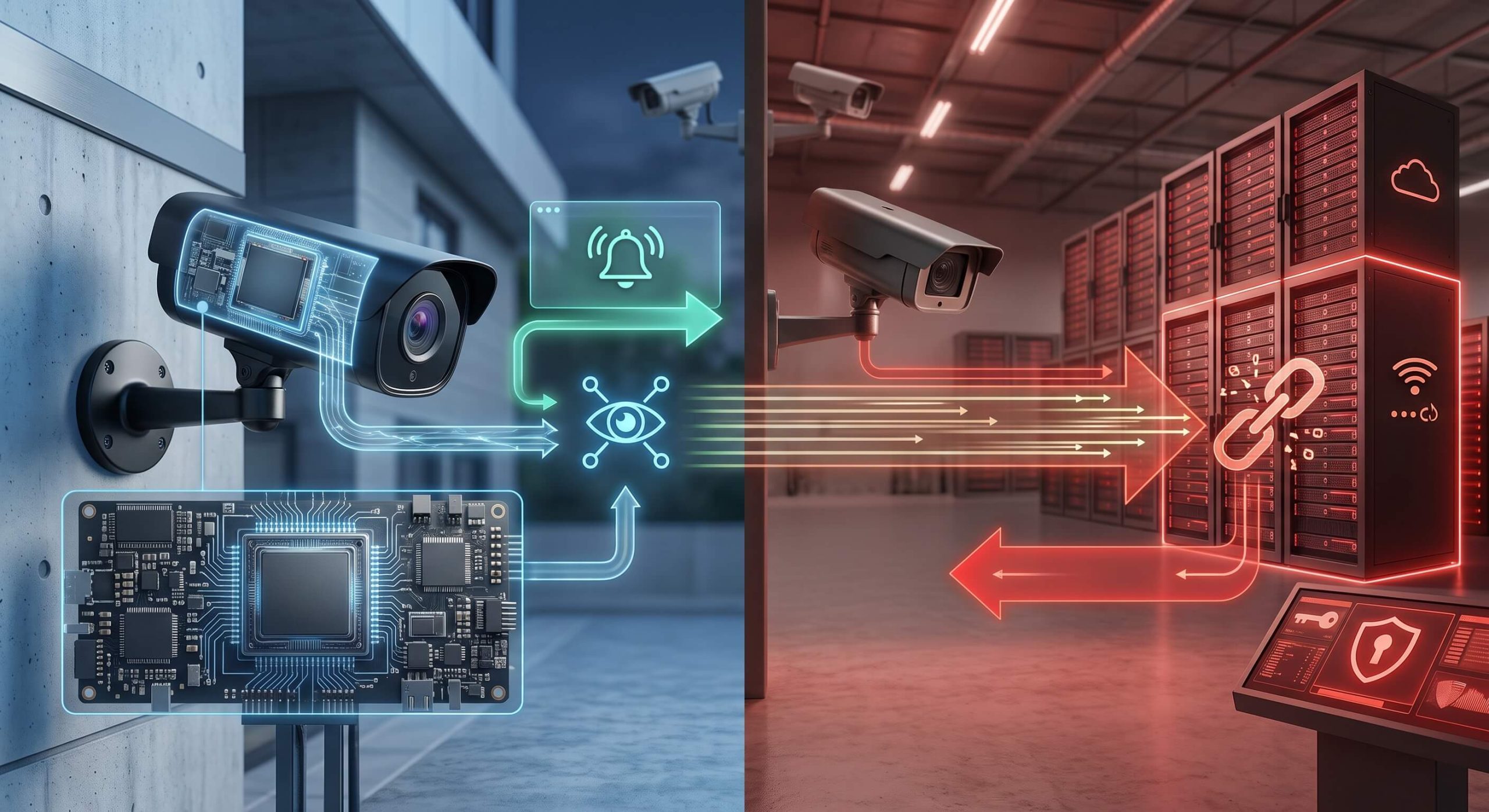
Artificial intelligence has transformed video surveillance from passive recording into a tool capable of identifying suspicious behavior and alerting security teams to potential threats. But where that analysis takes place can significantly affect how efficiently the system operates.
Cloud-only analytics require camera data to travel across a network for processing before results are returned. Edge AI processes information locally, reducing the amount of data transmitted over the internet while also eliminating unnecessary round trips to remote servers [1]. For organizations managing large camera deployments, moving more computer vision processing directly onto the camera can create measurable advantages in performance, resilience, and long-term operating costs.
Here are five reasons why on-device security camera AI can deliver stronger ROI than relying exclusively on cloud-based video analytics.
Reason 1: On-Device AI Processes Video Where It Is Created
Modern security cameras are increasingly becoming intelligent sensors rather than simple video capture devices. Instead of depending entirely on remote infrastructure, newer cameras can contain dedicated AI hardware capable of running computer vision models locally.
A key part of that shift is the neural processing unit, or NPU. NPUs and other AI accelerators are specialized processors designed to perform AI inference efficiently on edge devices [1]. In practical terms, this means the camera itself can analyze what it sees and identify relevant objects, behaviors, or conditions before determining what information needs to leave the device.
Qualcomm describes this evolution as an industry shift toward AI-native cameras capable of real-time decision-making. Modern edge-first camera platforms can perform on-device perception without sending raw video to the cloud for analysis [2].
Reason 2: On-Device Processing Reduces Bandwidth Demands
High-resolution surveillance video generates a considerable amount of network traffic, especially across large facilities or multi-site deployments.
One NVIDIA intelligent video analytics example used 160 cameras streaming 720p video at 4 Mbps each, resulting in approximately 640 Mbps of aggregate bandwidth for the camera deployment [3]. While bandwidth requirements vary by resolution, frame rate, compression, and system design, the example illustrates how quickly network demand can grow as camera counts increase.
Processing more information at the edge can reduce that burden. Rather than continually sending every video stream upstream for behavioral analysis, systems can process data locally and forward the information that actually needs centralized attention.
Reason 3: On-Device Analytics Can Deliver Faster Security Alerts
Latency matters when video analytics are being used for active threat detection.
If a system identifies a potential firearm, perimeter breach, unauthorized entry, or another high-priority event, security personnel need that information as quickly as possible. Edge AI significantly reduces latency because information can be processed locally instead of being transmitted to a remote data center first [4].
For security and surveillance specifically, local computer vision can analyze suspicious activity and trigger alerts without waiting for cloud-based processing. That faster path from detection to action can be particularly valuable in environments where seconds matter.
Reason 4: Critical Analytics Can Continue During Network Disruptions
A cloud-dependent analytics platform is also dependent on the connectivity required to reach it.
Edge AI devices can continue processing data locally even when network connectivity becomes unstable or unavailable [1]. That means a corporate WAN outage does not necessarily have to stop critical analytics running on the camera itself.
Remote notifications may still require an available communication path, but the underlying detection capability can continue operating locally. This resilience can be especially important for remote facilities, distributed enterprises, and other locations where uninterrupted connectivity cannot always be guaranteed.
Reason 5: On-Device AI Can Strengthen the ROI of a Camera Upgrade
Advanced cameras with on-device processing capabilities may require a greater capital investment than basic IP cameras, but acquisition cost is only part of total ownership.
Processing data at the edge can reduce cloud workloads, bandwidth requirements, and related operational costs [4, 5]. Edge storage strategies can also reduce the amount of information sent to centralized infrastructure, helping lower cloud storage and data-transfer expenses.
Combined with faster alerts, greater resilience, and more efficient use of security personnel, those savings can help justify investment in modern camera infrastructure.
Build a Smarter Video Security Architecture with Surveillance Secure
Edge and cloud technologies do not have to be an either-or decision. A well-designed system can use on-device intelligence for time-sensitive analytics while maintaining centralized resources for management, long-term storage, and deeper analysis.
If your organization is considering AI video analytics or planning a camera modernization project, contact Surveillance Secure to build a video security architecture that balances on-device intelligence, centralized management, network performance, and long-term operating costs.
Sources:
- https://www.ibm.com/think/topics/edge-ai
- https://www.qualcomm.com/news/onq/2026/03/qualcomm-insight-platform-edge-ai-security
- https://developer.nvidia.com/blog/accelerating-iva-using-ultra-efficient-5g-core-with-mavenir-and-nvidia-edge-ai/
- https://www.ibm.com/think/topics/edge-vs-cloud-ai
- https://www.ibm.com/think/topics/edge-storage


 Virginia DCJS Private Security Services ID #11-6085